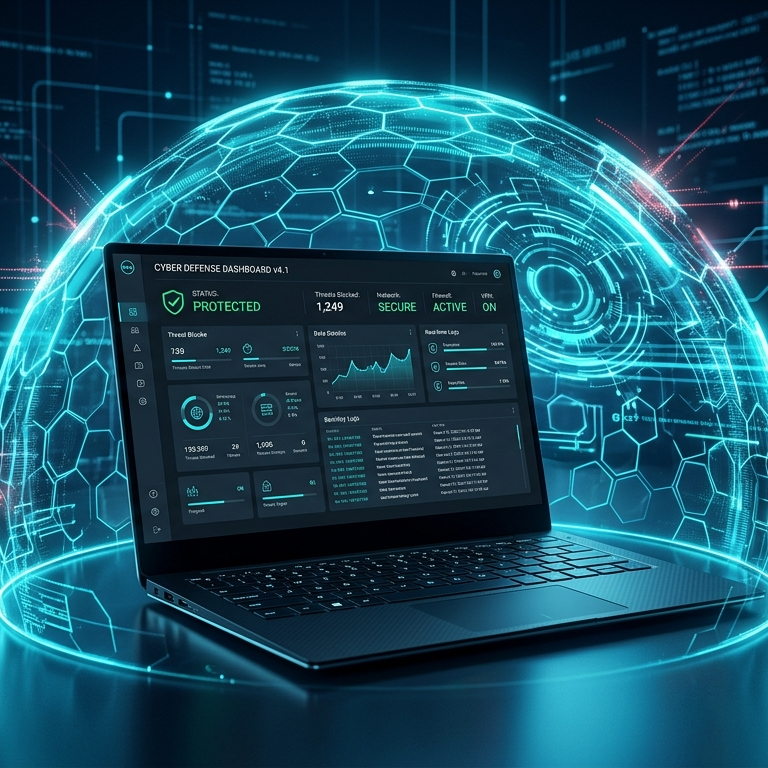
AI deepfakes and scams are challenging digital safety in 2026. See how artificial intelligence is rewriting the rules of authenticity regarding AI deepfakes and scams.

AI can now generate realistic images, imitate voices, and create convincing video. The question is no longer whether something is real — it’s how you know it’s real.
Table of Contents
- Navigating AI Deepfakes and Scams in the New Era of Fake
- Why Your Voice Is No Longer Proof Against AI Deepfakes and Scams
- The Bigger Problem With AI Deepfakes and Scams Is Trust
- The New Rule to Fight AI Deepfakes and Scams: Verify, Then Trust
- When AI Deepfakes and Scams Become a Business Problem
- Frequently Asked Questions About AI Deepfakes and Scams
For most of the internet’s history, seeing something was considered evidence regarding AI deepfakes and scams.
You saw someone’s face. You heard their voice. You watched a video. You received a message from someone you knew.
That was usually enough.
AI is changing that.
Artificial intelligence can now generate realistic images, imitate voices, create convincing video, and produce messages that sound remarkably human, amplifying the risks surrounding AI deepfakes and scams.
The problem isn’t that fake content exists. It’s that fake content is becoming harder to recognize.
At RytPik, we help businesses protect themselves from AI-powered threats — the ones that don’t look like attacks but can cost you everything. Here is what every business owner needs to know about AI deepfakes and scams in 2026.
Navigating AI Deepfakes and Scams in the New Era of Fake
Deepfakes were once mostly associated with celebrity face-swaps and internet experiments.
That’s changed.
In March 2026, Canada’s Competition Bureau warned that fraudsters are using AI to impersonate government officials, politicians, and other recognizable figures, including through deepfake videos and fake government websites (learn more via Canada.ca).
And video is only part of the problem when dealing with AI deepfakes and scams.
AI can imitate the way someone writes, clone a person’s voice, generate convincing images, and create websites that closely resemble legitimate businesses.
The question is no longer simply: “Is this real?”
It’s: “How do I know it’s real?”
$1.1 billion lost to deepfake-related scams and fraud schemes worldwide in 2025 — and the numbers are rising in 2026.
Why Your Voice Is No Longer Proof Against AI Deepfakes and Scams
Voice cloning may be one of the most unsettling developments in modern AI deepfakes and scams.
A short recording can provide enough material for AI to generate convincing speech in someone’s voice.
Imagine receiving a call from your boss asking you to urgently transfer money.
The voice sounds exactly right. The request sounds plausible. The urgency makes sense.
Would you question it?
24% of Canadian organizations that experienced fraud reported executive voice-clone impersonation calls, according to KPMG Canada’s 2026 Business Fraud Survey.
AI-generated phishing emails and chats affected 60% of surveyed organizations, while deepfake documents affected 39%.
The voice you trust may no longer be proof of identity.
The Bigger Problem With AI Deepfakes and Scams Is Trust
AI isn’t only changing technology. It’s changing what we trust.
Businesses have traditionally relied on assumptions:
- “That’s my manager’s voice.”
- “That’s our supplier’s email.”
- “That’s the company website.”
- “That’s the person on the video call.”
Those assumptions are becoming less reliable.
The Digital ID & Authentication Council of Canada has described synthetic identities and deepfakes as an active threat to Canadian organizations, warning that sophisticated identity fraud can exploit gaps between different institutions.
That creates a fundamental problem: Identity can no longer simply be accepted. It has to be verified.
Protecting your enterprise networks against modern AI deepfakes and scams requires multi-layered verification protocols.
The New Rule to Fight AI Deepfakes and Scams: Verify, Then Trust
The answer isn’t to stop using technology. It’s to stop treating appearance as proof.
- Verify unusual payments: Confirm requests through a second channel using contact information you already have.
- Don’t trust supplied contact details: If an unexpected message provides a phone number or email for verification, use the contact information already in your records.
- Check websites carefully: Look for unusual domains, extra characters, misspellings, or unexpected redirects before entering credentials.
- Slow down urgent requests: Pressure is often part of the scam. A legitimate request can usually survive a verification step.
- Use multiple approvals: High-value financial or administrative actions should require independent confirmation.
- Train continuously: Employees need regular exposure to evolving phishing, impersonation, and AI-generated fraud techniques.
Because when AI can imitate the person giving the instruction, the process has to become the verification.

When AI can imitate the person giving the instruction, verification becomes the only reliable defense.
When AI Deepfakes and Scams Become a Business Problem
This stops being a story about strange AI videos on the internet. It becomes a business problem.
94% of surveyed Canadian business leaders are concerned about AI-powered attacks, yet only 26% report having a comprehensive, tested response plan for threats such as deepfakes and voice clones.
72% of Canadian businesses lost between 1% and 5% of their annual profits to AI-powered fraud attacks in the past 12 months.
That gap between concern and preparedness matters.
Businesses can no longer depend entirely on employees recognizing what’s fake. They need stronger authentication, access controls, verification procedures, employee awareness, monitoring, and tested response plans.
That’s where RytPik comes in.
RytPik helps small and growing businesses strengthen the systems, people, and processes that protect against modern cyber threats — including the increasingly convincing impersonation attacks made possible by AI.
Because cybersecurity isn’t only about protecting computers anymore. It’s about protecting trust, identity, money, and the decisions your business makes every day.
When everything can be faked, verification becomes security.
Don’t just trust it. Verify it.
Frequently Asked Questions About AI Deepfakes and Scams
Q: What is a deepfake?
A deepfake is AI-generated or digitally manipulated content designed to convincingly depict a person or situation. It can involve video, images, or audio.
Q: Can AI really clone someone’s voice?
Yes. Voice-cloning technology can imitate a person’s voice from recorded samples. That’s why unexpected requests involving money, credentials, or sensitive information should be independently verified.
Q: How can businesses protect themselves from AI impersonation?
Businesses should combine strong authentication, access controls, employee training, independent verification procedures, monitoring, and a tested incident-response plan. Read about common cybersecurity mistakes →
Q: Is AI making cybersecurity more difficult?
Yes. AI can make scams faster to produce and harder to recognize. Verification procedures and layered security are therefore becoming increasingly important. Learn more about email and mobile security →
Get Protected With RytPik
The businesses best prepared for cyber threats aren’t necessarily those with the biggest technology budgets. They’re the businesses that understand their exposure and address weaknesses before attackers discover them.
Don’t trust the appearance. Verify the source.
RytPik — Helping Businesses Grow with Confidence Through Enterprise-Grade Cybersecurity.
Explore more RytPik resources: